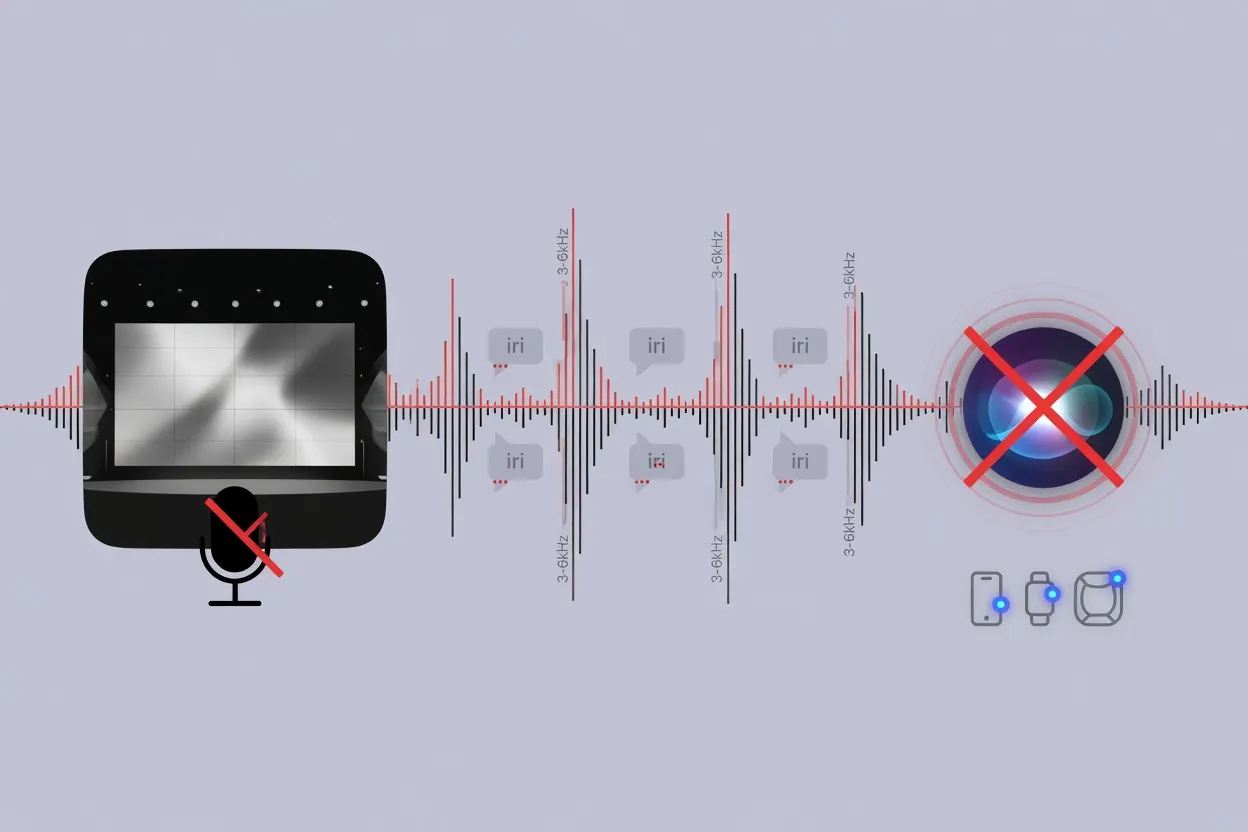
Apple quietly edited its own keynote audio to keep your devices from interrupting the show.
Spectrograms shared on X after the WWDC 2026 keynote revealed that Apple cut the 3kHz, 4kHz, 5kHz, and 6kHz frequency bands from the audio track each time a presenter said "Siri." The goal was to degrade the acoustic signature of the wake word enough that nearby HomePods, iPhones, iPads, and Macs would fail to recognize it and stay quiet. The notching is precise and repeatable — it appears at every instance of the word throughout the video, which rules out compression artifacts or coincidence.
Wake-word detection works by matching a phonetic fingerprint, and those mid-range frequencies carry a lot of the consonant energy that makes "Siri" sound like "Siri." Carving them out is a reasonable engineering bet. What makes this worth noting is that Apple had to make it at all: it is an admission that the company still has no cleaner solution to a problem the whole industry has wrestled with for years — how do you demo a voice assistant on a livestream without turning every viewer's living room into an accidental participant?
Amazon has faced the same issue with Alexa demos; Google has run into it with "OK Google." The difference is that Apple's workaround was technically creative enough to show up in a spectrogram. It was also, by multiple viewer reports, not creative enough to actually work — devices still triggered during the stream.
For a company that spent a significant portion of the keynote positioning Siri as smarter and more capable than before, having it activate uninvited on cue is an awkward footnote.