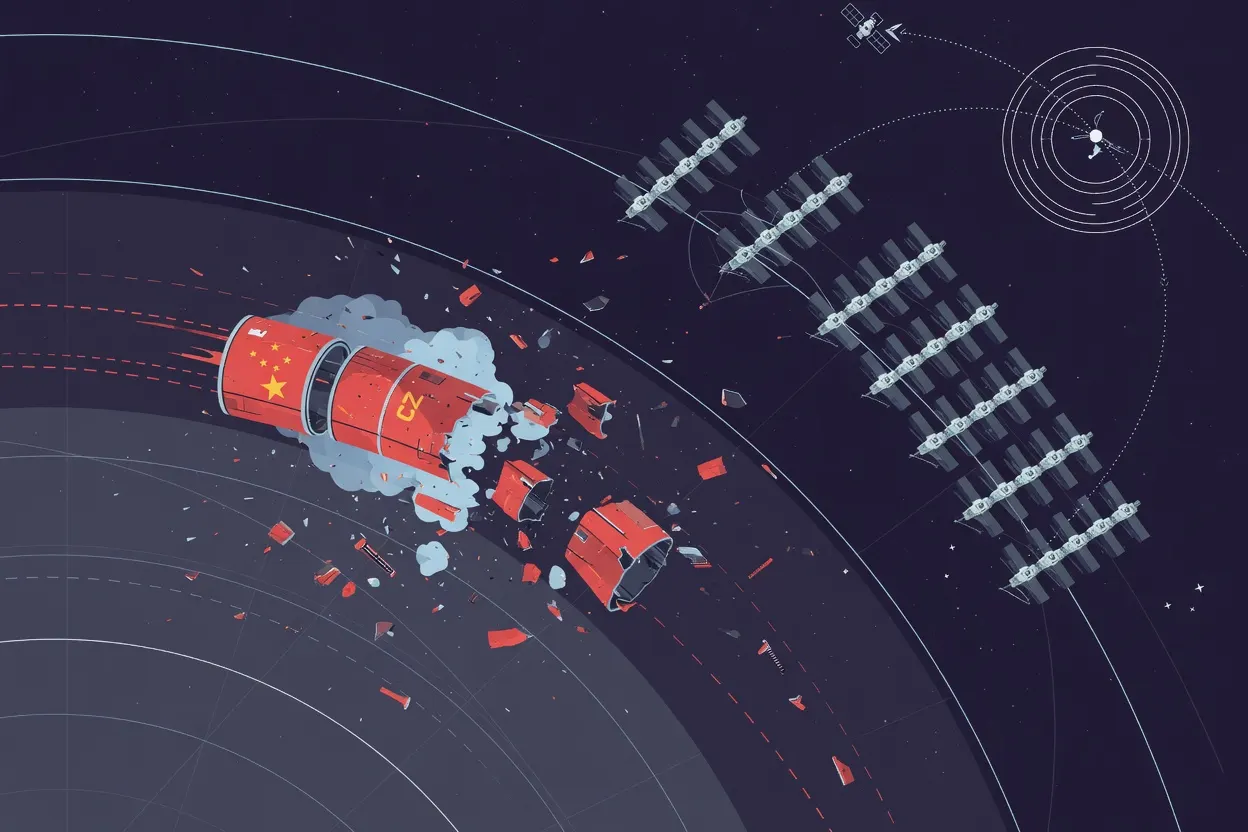
A Chinese commercial rocket's upper stage disintegrated in low-Earth orbit, adding a fresh debris cloud to an already crowded altitude band.
The Zhuque-2E rocket launched June 9, delivering two direct-to-cell communications satellites before its upper stage apparently failed to complete a planned disposal burn. Shortly after, the stage broke apart. The US Space Force confirmed the event via space-track.org, the military's public orbit-data portal, and said tracked fragments are being folded into routine conjunction assessments. As of its advisory, the Space Force found no immediate threats to human spaceflight — but noted analysis is ongoing.
The debris field sits in a slice of low-Earth orbit shared by the International Space Station and a large share of SpaceX's Starlink constellation, which now numbers well over 6,000 satellites. That density is precisely what makes upper-stage breakups costly: even a modest debris cloud forces operators to run avoidance maneuvers, burning fuel and disrupting service windows. The more satellites in a band, the more conjunctions each fragment creates. SpaceX has faced this math before with other operators' hardware; now it faces it again, and closer to home.
Launches from private Chinese operators like Landspace — the company behind Zhuque-2E — are multiplying, but their debris-mitigation track record is thin. The disposal burn that apparently didn't happen is exactly the kind of end-of-mission procedure that keeps orbital lanes usable. Whether this was a hardware failure or a planning gap, the result is the same: more junk in a neighborhood that can't afford more junk.