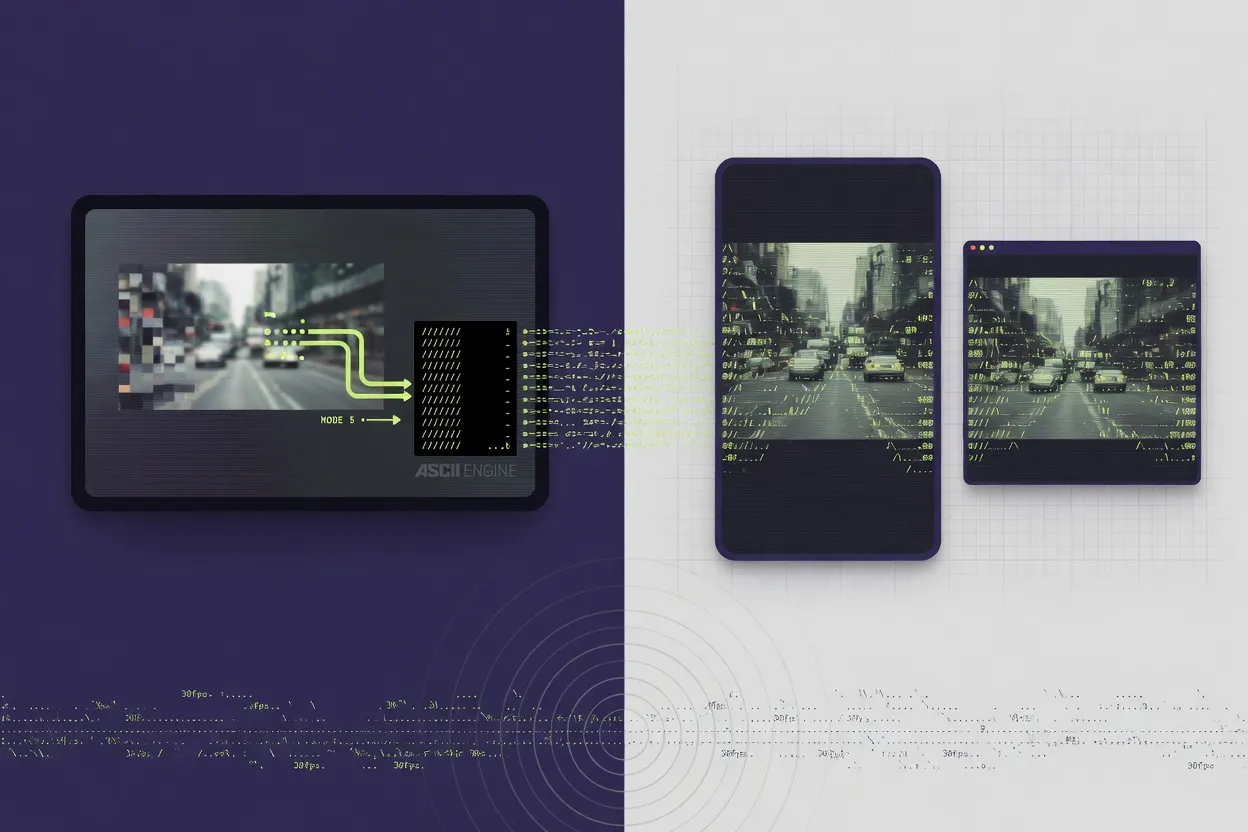
A developer has built a real-time ASCII video engine that converts live footage to plain text — and claims standard blockers can't touch it.
The software renders video as streams of ASCII characters at 360p and 30 frames per second using what the developer calls Mode 5 rendering. The pitch runs on two tracks: first, that text-based streams sidestep the filters and geographic blocks built around standard video codecs and container formats; second, that plain-text output makes video content readable by AI systems that handle text but not raw frames. The developer markets the whole package as a "bridge for AI" and an unblockable broadcast medium.
The filter-resistance claim has genuine logic behind it. Content moderation infrastructure is almost entirely designed around image and video formats — codec signatures, container headers, pixel-level hashing — not character streams. A plain-text representation of a live video feed is structurally invisible to most of that tooling, which is either a clever engineering observation or a fairly obvious abuse vector, depending on who's deploying it.
The AI-bridge framing is the more durable pitch. Most large language models can process text but can't ingest raw video without a multimodal layer on top; ASCII conversion is a low-overhead way to pipe visual context into a text-only pipeline. Whether anyone actually wants to watch video rendered in ASCII at 360p is a separate and reasonable question.